Airsoft Battery Labels: What the Terms Mean
A plain-English workshop note on chemistry, capacity markings, equipment manuals, and the checks that keep a questionable power pack out of your field bag.
Getting started
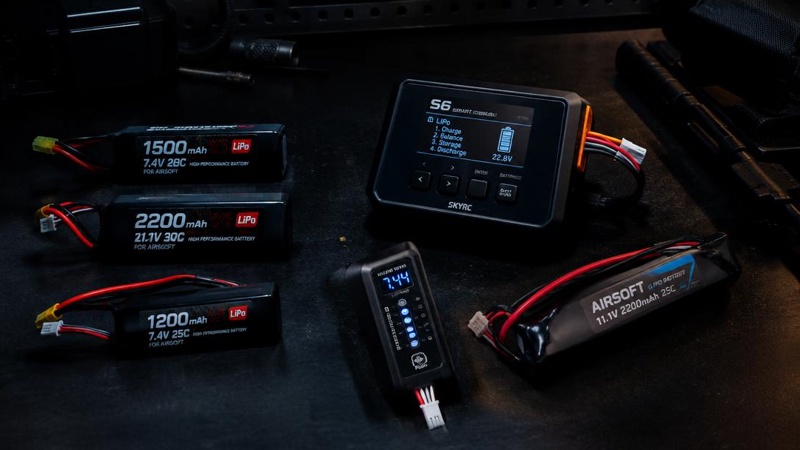
Most of us carry a power pack or two in our kit bag, and it is surprising how often these items are not of sufficient power to supply the equipment we have in our kit. The labels on power packs contain a mass of information including the chemistry name, the capacity, and a short abbreviation for each parameter. The label is often written in terms that are meaningless to a casual player, but it is just a few seconds work to enable the player to accurately identify all of his spare AEG batteries, to detect obvious damage, and to ensure that he has the correct accessories with him.
Start with the equipment manual
Start by reading the equipment manual, looking for information on the battery type, the battery format, and the voltage, the connections, and the space available in the compartment. The manual will contain much more useful information than the label on a spare pack of batteries. When looking for information on a spare pack of batteries, use the equipment manual for the particular model of equipment that the pack is to be used with, rather than with the manual for the pack itself.
Compatibility problems often surface at the worst moment: when going to play. And the root cause of problems is simple: two batteries looking alike can in fact be completely unsuitable for the same AEG. While reading the labels, in addition to checking for the mentioned markings, it is necessary to check for the compatibility of the battery’s chemistry, for the description of voltage, for the type of connectors used, and the available space inside the AEG’s battery compartment.
You would look for documentation (eg. a printed manual) supplied with the specific model of equipment, not the images on a website. Loose or awkward fitting packs could be pinched or forced into position. Alternatively, leads could be placed under pressure. These potential problems could be avoided by checking the equipment out before packing it for the field.
Chemistry names are not interchangeable
These 3 terms refer to the chemistry or materials used in the battery. As mentioned before, the different battery types are NiMH, LiPo and Li-ion. While some people use these terms to refer to different models or variations of the same chemistry, these 3 terms actually refer to 3 completely different types of battery chemistry.
Match the battery chemistry named in the manual. A similar-looking plug cannot tell you whether a pack is suitable.
A loose power pack can be inconvenient for a kit bag but a much more serious problem when it comes to actually using the power pack. Labels can have lots of short abbreviations and be a mix of the name of the chemicals in the pack and the capacity (in mAh) of the pack. The first thing to check is the equipment manual for the relevant AEG for the label terms for that AEG’s battery(s) in the kit bag. Note, that just because a spare power pack has a plug that looks similar to that of the battery for an AEG in your kit bag, does not necessarily mean that it is suitable for use with that AEG.
Reading capacity without overreading it
Capacity is usually expressed in mAh (milliamp-hours). This figure represents how much charge a pack can hold. Obviously, the higher the capacity of a battery the more time you will have with your AEG. But be aware that higher capacity usually means a larger and heavier pack.
A larger pack may physically fit differently. The number in mAh doesn't tell you the dimensions, compatibility or condition of the battery.
Many battery packs have additional labels that need to be read. Other labels state the number of cells in the pack, the nominal voltage, and the battery’s discharge rating. Compare these numbers to the manual, not to other batteries. It does not matter how the other batteries read. If you cannot make sense of a number, then mark that pack for another time and continue to look for a suitable battery.
Make the condition check part of packing
Inspect the batteries for swelling, dents, cracks, broken or split sealing, exposed wire ends, frayed wires, loose connections, signs of leakage and any burn marks. Also check the storage pouch for sharp objects that could puncture the battery’s insulation.
Set the potentially defective pack(s) aside (and mark them) – do not pack them and stow them in the bottom of your kit bag! Same goes for any AEG or accessory compartment that has been subjected to any form of crush, rubbing or overheating of a spare pack! Make sure to inspect said AEG or accessories before packing them.
Store your spare batteries by gear, by chemistry and clearly labeled. A small pouch, a note and the manual for the relevant equipment all stored with the rest of your kit will stop you having to do a rushed comparison of labels in the middle of a busy field.
Found this guide useful? Share it with your team.